Scapholunate Ligament Injury Protocol
Acute/Chronic Scapholunate Dissociation (SLD) Injury
Conservative Management
General rule: Acute refers to 1 – 9 weeks from injury. Chronic refers to more than 9 weeks from injury.
0 – 3 (chronic) / 0 – 4 (acute) weeks
A wrist brace is prescribed for total immobilization.
Initiate AROM of unaffected joints 3 times a day, 10 repetitions.
Patient education on joint protection to optimize healing of SLD. Avoid loading over the affected hand (e.g. pulling, pushing, weight bearing and carrying heavy things). Avoid forceful grasp and grip. Avoid usage of affected hand in extreme wrist positions.
3 (chronic) / 4 (acute) weeks from bracing
Intermittent wrist brace.
Initiate Dart Thrower’s Motion, 3 times a day, 10 repetitions.
6 weeks from bracing
Intermittent wrist brace.
Initiate AROM of wrist, 3 times a day, 10 repetitions.
Initiate isometric strengthening exercises for FCR and ECRB/L, 3 times a day, 3 sets of 10 repetitions, hold 5 seconds for each repetition, 2 minutes rest break in between sets.
8 weeks from bracing
Discontinue wrist brace.
Initiate AROM of wrist, 3 times a day, 10 repetitions.
Continue isometric strengthening exercises for FCR and ECRB/L.
Initiate isometric strengthening of general wrist flexors and extensors, 3 times a day, 3 sets of 10 repetitions, hold 5 seconds for each repetition, 2 minutes rest break in between sets.
Initiate proprioceptive reeducation with conscious co-contraction of the wrist muscles with 1) circulating ball in basin and 2) throw and catch ball. 3 times a day, go up to 100 circles each time.
12 weeks from bracing
Initiate PROM to wrist if functional AROM not achieved at this point, 3 times a day, 10 repetitions.
Progress to isotonic strengthening exercises for FCR and ECRB/L.
Initiate isotonic strengthening of general wrist flexors and extensors.
Initiate grip strengthening with stress ball.
All strengthening exercises to be perform 3 times a day, 3 sets of 10 repetitions, hold 5 seconds for each repetition, 2 minutes rest break in between sets.
Initiate proprioceptive reeducation with conscious co-contraction of the wrist muscles with balancing water in basin. 3 times a day, balance for up to 5 minutes each time.
16 weeks from bracing
Gradual return to normal activities that involve weight bearing or loading with forearm in pronation.
Initiate push ups, starting in incline position such as wrist is not in extreme extension then slowly reduce the inclination (e.g. making use of table top or stairs) and increase the number of push ups done.
Progress to reactive muscle training with unconscious co-contraction of wrist muscles using the PowerBall. Get patient to start by maintaining at 3000 – 5000 rpm for 3 sets of 2 minutes, with 2 minutes rest breaks in between. Can progress to as high an rpm they can maintain for 5 minutes continuously. Encourage patient to purchase powerball to practice 3 times a day.
20 weeks from bracing
Discharge if nil issue and patient satisfied with function.
Therapy Protocols
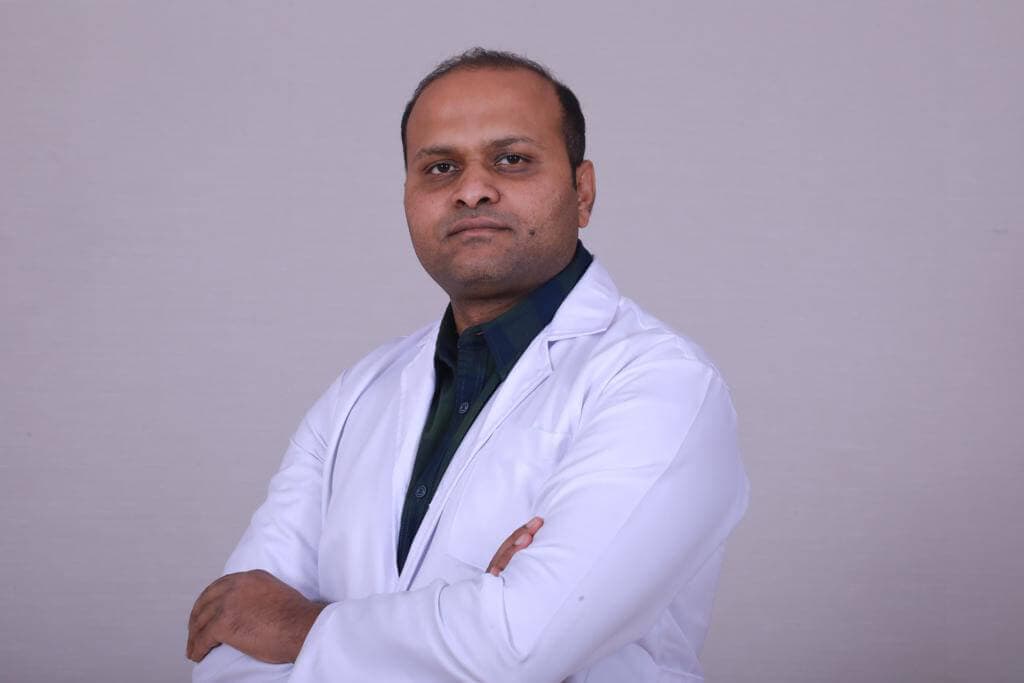
Dr. Sathya Vamsi Krishna
- MBBS MS (Ortho) European Diploma in Hand Surgery
- Dr Paul Brand Fellowship in Hand and Reconstructive Microsurgery (CMC Vellore)
- Fellowship in Hand and Microsurgery (National University Singapore)
- Fellowship in Hand and Upper Extremity Surgery (Institut Kaplan, Barcelona)
What is hand surgery?
Why visit a hand surgeon?
What are common symptoms in hand and upper limb?
- Pain
- Tingling or numbness affecting upper limb.
- Difficulty is performing daily task using hands.
- Any injury ranging from simple sprain to fracture.